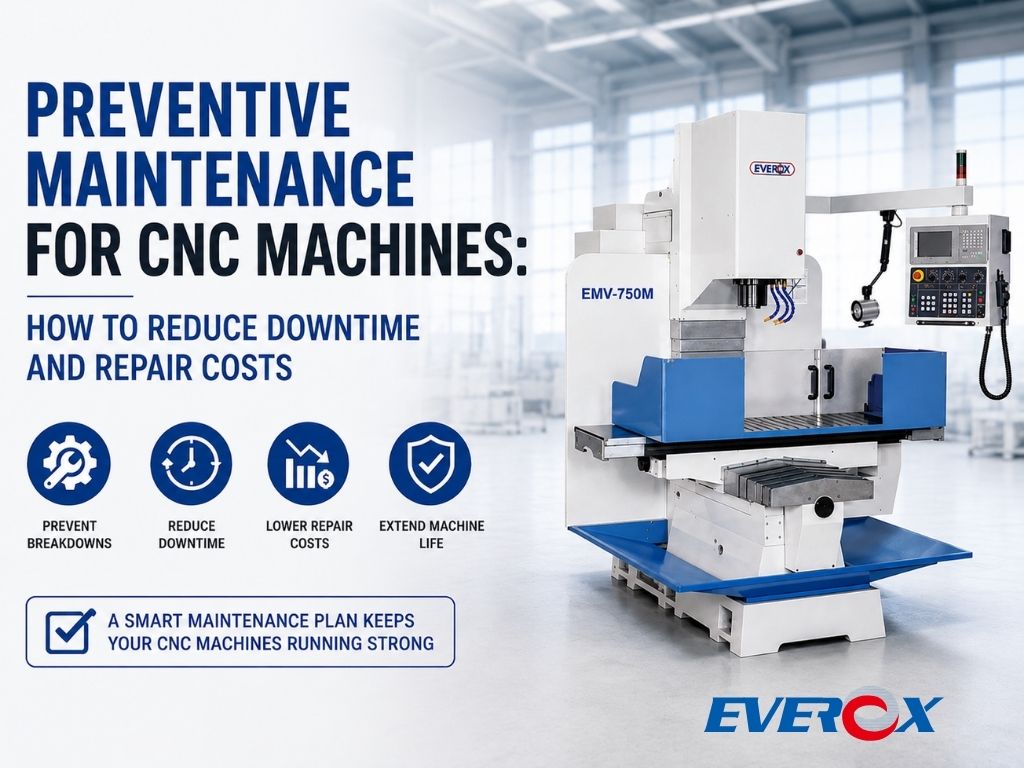
Preventive Maintenance for CNC Machines: How to Reduce Downtime and Repair Costs
Introduction: CNC Maintenance Is a Production Strategy, Not Just a Repair Task
When a CNC machine stops unexpectedly, the cost is rarely limited to the repair itself. Unplanned downtime can interrupt production schedules, leave operators waiting, delay downstream processes, and potentially affect delivery commitments.
For this reason, preventive maintenance for CNC machines should be treated as part of production management rather than simply a maintenance department responsibility. The objective is to identify developing problems before they cause machine failure, while keeping critical systems operating within appropriate conditions.
At EVEROX Industrial Co., Ltd., we understand that CNC machines are long-term production assets. Whether operating CNC lathes, CNC milling machines, or vertical machining centers, manufacturers can benefit from a structured preventive maintenance strategy that balances machine condition, production demands, and maintenance costs.
This article explains how preventive maintenance can help reduce unexpected downtime and repair expenses—and how manufacturers can build a more effective maintenance strategy without simply performing more maintenance.
Table of Contents
- What Is Preventive Maintenance for CNC Machines?
- Why Unexpected CNC Machine Downtime Costs More Than Repairs
- How Preventive Maintenance Reduces CNC Machine Downtime
- How Preventive Maintenance Helps Control Repair Costs
- Which CNC Machine Components Should Be Prioritized?
- Preventive vs. Reactive Maintenance
- How to Build an Effective CNC Preventive Maintenance Plan
- Avoid Over-Maintenance: More Maintenance Is Not Always Better
- When Maintenance Is No Longer the Most Economical Option
- EVEROX CNC Machine Solutions for Long-Term Production
- Frequently Asked Questions
- Conclusion
What Is Preventive Maintenance for CNC Machines?
Preventive maintenance is a planned approach to inspecting, servicing, and monitoring CNC machines before failures occur.
Unlike reactive maintenance, which begins after a component fails or a machine stops operating, preventive maintenance uses scheduled inspections and machine-condition observations to identify potential problems earlier.
Typical activities may include:
- Cleaning chips and machining residue
- Checking lubrication systems
- Monitoring coolant condition
- Inspecting hydraulic and pneumatic systems
- Checking spindle condition
- Monitoring guideways and axis movement
- Inspecting filters and cooling systems
- Checking tooling interfaces
- Monitoring unusual vibration, noise, or temperature
- Periodically verifying machining accuracy
The exact maintenance requirements depend on the machine design, operating hours, cutting conditions, and manufacturer's recommendations.
The goal is therefore not to apply the same maintenance schedule to every CNC machine. It is to establish a maintenance routine appropriate for the equipment and its actual operating environment.
Why Unexpected CNC Machine Downtime Costs More Than Repairs
When manufacturers calculate the cost of a machine breakdown, replacement parts and technician fees are often the most visible expenses.
However, the actual cost of unplanned downtime can extend much further.
A CNC machine failure may result in:
- Lost production hours
- Idle operators
- Interrupted production schedules
- Delayed downstream operations
- Overtime required to recover production
- Expedited replacement parts
- Emergency service expenses
- Delayed customer deliveries
For example, if one CNC machine feeds parts into another machining, inspection, or assembly process, an unexpected breakdown can affect more than one workstation.
This is why downtime should be evaluated in terms of its production impact, not simply the cost of repairing the failed component.
How Preventive Maintenance Reduces CNC Machine Downtime
Preventive maintenance cannot guarantee that a CNC machine will never fail. What it can do is improve the likelihood that developing problems are discovered before they become unexpected production interruptions.
1. Identify Abnormal Conditions Earlier
Many machine problems develop gradually.
Operators may notice:
- Increasing spindle vibration
- Unusual bearing or axis noise
- Higher operating temperatures
- Lubricant or coolant leakage
- Irregular axis movement
- Repeated alarms
- Gradual deterioration in machining accuracy
Individually, these symptoms may not stop production immediately. However, ignoring them can allow a minor problem to develop into a more serious failure.
A structured inspection routine gives operators and maintenance personnel an opportunity to investigate these changes earlier.
2. Schedule Maintenance Around Production
There is a major difference between:
“This machine needs maintenance next Friday.”
and
“This machine has stopped in the middle of today's production schedule.”
Planned maintenance allows manufacturers to coordinate servicing around available production windows, prepare necessary replacement components, and allocate personnel in advance.
Even when maintenance requires several hours of downtime, planned downtime is generally easier to manage than an unexpected failure.
3. Reduce Secondary Damage
A developing component problem does not always remain isolated.
For example, inadequate lubrication can increase wear on moving components, while abnormal spindle conditions can eventually affect machining accuracy and surface quality.
Identifying the original issue earlier may prevent additional components or production results from being affected.
How Preventive Maintenance Helps Control Repair Costs
Preventive maintenance does not eliminate maintenance expenses. In fact, a proper maintenance program requires planned labor, inspection, consumables, and periodic component replacement.
The financial benefit comes from controlling when and how maintenance costs occur.
Reduce Emergency Repairs
Emergency repairs may require urgent technical support, expedited parts delivery, overtime labor, and immediate production rescheduling.
Preventive maintenance can help convert some of these unpredictable expenses into planned maintenance activities.
Extend the Useful Life of Components
Lubrication, contamination control, coolant management, and proper operating conditions can help reduce unnecessary wear on machine components.
This is particularly important for components and systems such as:
- Guideways
- Ball screws
- Spindles
- Bearings
- Hydraulic systems
- Lubrication systems
- Tool-changing mechanisms
Maintenance cannot prevent normal wear indefinitely, but appropriate maintenance can help components operate under their intended conditions.
Prevent Quality Problems from Becoming Hidden Costs
Machine condition and machining quality are closely connected.
Changes in spindle performance, positioning accuracy, machine geometry, or tooling interfaces may eventually contribute to:
- Dimensional variation
- Poor surface finish
- Increased rework
- Scrap
- Additional inspection
- Longer production time
These quality-related costs may occur before the machine experiences a complete breakdown.
Preventive maintenance therefore helps protect not only machine availability but also process consistency.
Which CNC Machine Components Should Be Prioritized?
Not every machine component carries the same risk or requires the same inspection frequency. A useful preventive maintenance plan should prioritize systems that directly influence machine operation, accuracy, and reliability.
| System / Component | What to Monitor | Potential Impact if Neglected |
|---|---|---|
| Lubrication System | Oil level, delivery, leakage, contamination | Increased friction and component wear |
| Spindle | Noise, vibration, temperature, runout | Poor surface finish, accuracy problems, possible spindle damage |
| Guideways & Ball Screws | Lubrication, movement, noise, positioning behavior | Reduced positioning accuracy and inconsistent movement |
| Coolant System | Level, concentration, contamination, flow | Cutting instability, heat control issues, shorter tool life |
| Hydraulic / Pneumatic System | Pressure, leakage, hoses, connections | Unstable clamping or machine functions |
| Tooling Interfaces | Chips, wear, damage, seating | Runout, vibration, poor machining consistency |
| Filters & Cooling Systems | Contamination and airflow | Increased operating temperature and electrical problems |
| Machine Accuracy | Positioning, repeatability, finished-part dimensions | Scrap, rework, and inconsistent production |
The exact components and maintenance procedures vary by CNC machine type and model. Always refer to the manufacturer's maintenance documentation before performing service or adjustment.
Preventive vs. Reactive Maintenance: What Is the Real Difference?
Reactive maintenance may appear less expensive because maintenance is performed only when something goes wrong. However, this approach can make downtime and repair costs difficult to predict.
| Factor | Reactive Maintenance | Preventive Maintenance |
|---|---|---|
| Timing | After a problem or failure occurs | Planned before major failure |
| Downtime | Often unexpected | More predictable |
| Production Planning | Difficult during breakdowns | Can be coordinated with production |
| Parts Preparation | May require urgent sourcing | Can often be prepared in advance |
| Maintenance Cost | Irregular and potentially high | More controlled and predictable |
| Failure Detection | Problems found after symptoms become serious | Developing issues may be identified earlier |
| Production Risk | Higher risk of interruption | Reduced risk of avoidable interruption |
This does not mean every CNC machine component should be replaced preventively.
An effective strategy combines scheduled maintenance with actual machine-condition monitoring.
How to Build an Effective CNC Preventive Maintenance Plan
A maintenance plan should be practical enough to follow consistently. An overly complicated system may look comprehensive on paper but become difficult to maintain in a real production environment.
Step 1: Start with the Machine Manufacturer's Requirements
The machine manual should be the foundation of the maintenance program.
Identify recommended intervals for lubrication, fluid replacement, filter replacement, inspection, adjustment, and other service activities.
Step 2: Separate Operator Checks from Technician Maintenance
Not every maintenance activity requires a maintenance technician.
Operators can often perform routine observations such as:
- Checking coolant levels
- Observing lubrication conditions
- Removing chips
- Looking for leaks
- Listening for abnormal noise
- Reporting unusual vibration or alarms
More technical procedures should be performed by appropriately trained personnel.
This division makes preventive maintenance easier to integrate into everyday production.
Step 3: Adjust Maintenance Frequency to Actual Usage
Calendar-based schedules alone may not reflect real machine usage.
Consider:
- Operating hours
- Number of shifts
- Cutting load
- Workpiece materials
- Chip generation
- Shop environment
- Accuracy requirements
A CNC machine running continuously under demanding conditions may require more frequent inspection than a machine used intermittently.
Step 4: Keep Maintenance Records
Maintenance records allow manufacturers to move beyond individual repair events and identify patterns.
Useful information to record includes:
- Inspection dates
- Alarm history
- Component replacements
- Lubricant and coolant service
- Accuracy checks
- Abnormal noise or vibration
- Repair history
- Machine downtime
If the same issue repeatedly appears, the records can help determine whether the problem requires further technical investigation.
Step 5: Review the Plan Periodically
Production conditions change.
New materials, higher utilization, tighter tolerances, additional shifts, or different machining processes may change the maintenance requirements of existing equipment.
A preventive maintenance plan should therefore be reviewed periodically rather than treated as a permanent schedule.
Avoid Over-Maintenance: More Maintenance Is Not Always Better
Preventive maintenance does not mean replacing components unnecessarily or stopping machines more frequently than required.
Excessive maintenance can create its own costs through:
- Unnecessary component replacement
- Additional labor
- Excessive planned downtime
- Unnecessary disassembly
- Increased maintenance inventory
The objective should be appropriate maintenance at the appropriate time.
Manufacturers can achieve this by combining three sources of information:
Manufacturer recommendations + operating history + actual machine condition
This approach helps maintenance teams focus resources on the systems and intervals that matter most.
When Maintenance Is No Longer the Most Economical Option
Preventive maintenance can extend useful machine life, but there is eventually a point where maintaining older equipment may no longer provide the best return.
Manufacturers should evaluate the situation when:
- Repairs become increasingly frequent
- Downtime repeatedly interrupts production
- Accuracy becomes difficult to maintain
- Spare parts become difficult to obtain
- Maintenance expenses continue to increase
- Production requirements exceed machine capability
- New jobs require greater accuracy, capacity, or efficiency
At this stage, the question changes from:
“How can we maintain this machine?”
to:
“Does continuing to maintain this machine still make economic sense?”
The decision should consider repair expenses together with lost production, machine availability, quality performance, future capacity requirements, and the expected cost of replacement.
EVEROX CNC Machine Solutions for Long-Term Production
Preventive maintenance plays an important role in maintaining CNC equipment, but long-term production performance also depends on selecting machinery that matches the application's machining requirements.
EVEROX Industrial Co., Ltd. provides a range of CNC machine tools for different production needs, including CNC lathes, CNC milling machines, vertical machining centers, and deep hole drilling machines.
Our machine tool solutions are developed with an emphasis on machining stability, structural rigidity, precision, and dependable operation for industrial production environments.
Whether you are expanding production capacity, replacing aging equipment, or evaluating a new CNC machine for future manufacturing requirements, selecting the appropriate machine configuration is an important part of controlling long-term operating costs.
Frequently Asked Questions About CNC Preventive Maintenance
1. How do I know whether my preventive maintenance schedule is frequent enough?
Review both the manufacturer's recommended intervals and actual machine history. If inspections repeatedly identify excessive contamination, lubrication issues, abnormal wear, or accuracy changes before the next scheduled service, the interval may need to be shortened. Operating hours and production conditions should also be considered.
2. Which CNC machine problems should not wait until the next scheduled maintenance?
Repeated alarms, abnormal spindle noise, excessive vibration, unusual temperature increases, lubrication failure, fluid leakage, irregular axis movement, or sudden changes in machining accuracy should be investigated promptly rather than waiting for the next scheduled service.
3. How can manufacturers measure whether preventive maintenance is working?
Useful indicators include unplanned downtime, emergency repair frequency, maintenance cost, machine availability, recurring alarms, scrap or rework associated with machine condition, and the frequency of unexpected component failures. Comparing these indicators over time can help determine whether the maintenance program is improving production reliability.
Conclusion: The Goal Is Predictable Production, Not Simply More Maintenance
The value of preventive maintenance for CNC machines is not measured by how many inspections are performed. It is measured by whether maintenance helps keep production more predictable.
By identifying developing problems earlier, planning maintenance around production schedules, monitoring critical machine systems, and maintaining useful service records, manufacturers can reduce avoidable downtime and gain better control over repair costs.
An effective preventive maintenance program should also evolve with the machine. Operating hours, cutting conditions, production volume, and accuracy requirements can change over time, so maintenance schedules should be reviewed accordingly.
As a CNC machine manufacturer in Taiwan, EVEROX Industrial Co., Ltd. provides CNC machine solutions for a wide range of manufacturing requirements. If your company is planning to expand production capacity or replace CNC equipment that has become increasingly costly to maintain, contact EVEROX to discuss a machine solution suited to your production requirements.