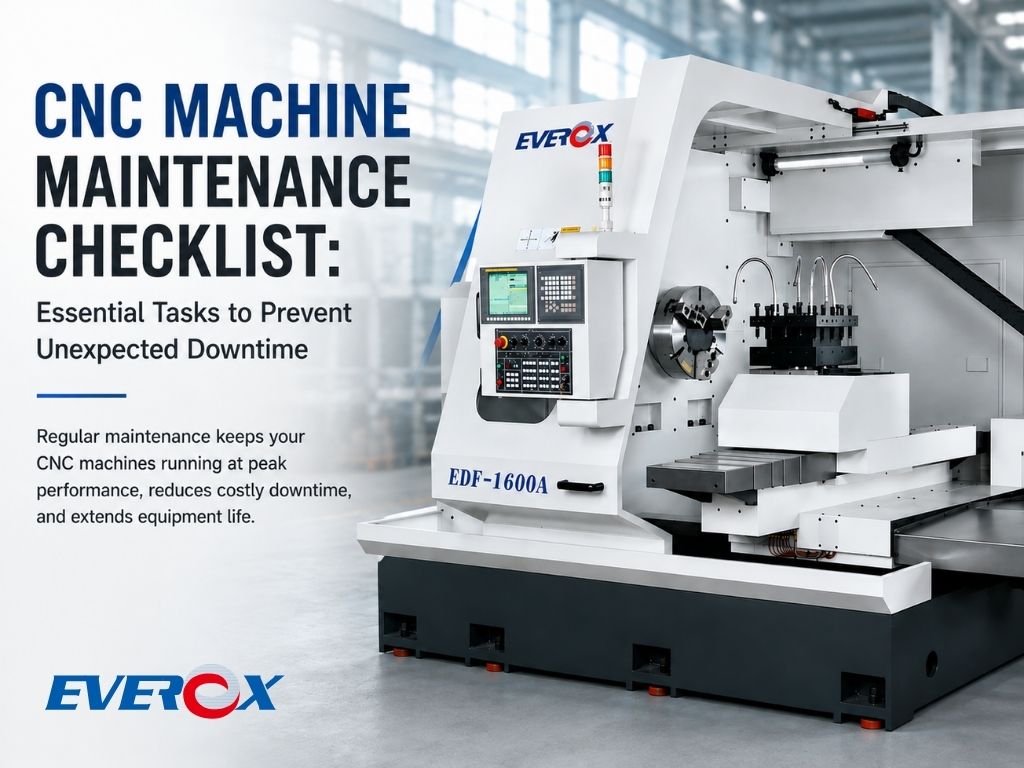
CNC Machine Maintenance Checklist: Essential Tasks to Prevent Unexpected Downtime
Introduction: Preventive Maintenance Starts Before Problems Appear
Unexpected CNC machine downtime can disrupt production schedules, delay deliveries, and increase operating costs. While component wear is unavoidable over the life of any machine tool, many problems can be identified earlier through regular inspection, cleaning, lubrication, and preventive maintenance.
A good CNC machine maintenance program is therefore not simply about repairing equipment after something fails. Its purpose is to maintain stable operating conditions, identify abnormal wear or performance changes early, and reduce the risk of unplanned interruptions.
At EVEROX Industrial Co., Ltd., we manufacture CNC machine tools for a variety of machining requirements, including CNC lathes, CNC milling machines, and vertical machining centers. Because machine configurations and operating environments vary, maintenance should always follow the specific machine manual and component manufacturer recommendations. However, the following checklist provides a practical framework for building a preventive maintenance routine.
Table of Contents
- Quick CNC Machine Maintenance Checklist
- Daily CNC Machine Maintenance
- Weekly CNC Machine Maintenance
- Monthly and Periodic CNC Machine Maintenance
- Daily, Weekly, and Periodic Maintenance at a Glance
- Maintenance Should Be Based on Operating Conditions
- When Routine Maintenance Is No Longer Enough
- EVEROX CNC Machine Solutions for Long-Term Production
- Frequently Asked Questions
- Conclusion
Quick CNC Machine Maintenance Checklist
Before looking at each maintenance interval in detail, these are the main areas manufacturers should routinely monitor:
- Machine cleanliness and chip accumulation
- Lubrication levels and lubrication system operation
- Coolant condition and coolant level
- Spindle condition and unusual noise
- Guideways and moving components
- Hydraulic and pneumatic systems, where applicable
- Tool holders and tool-changing components
- Electrical cabinets and cooling or ventilation
- Machine accuracy and positioning performance
- Abnormal vibration, temperature, noise, or alarms
The appropriate inspection frequency depends on operating hours, cutting conditions, materials, machine design, and the manufacturer's maintenance requirements.
Daily CNC Machine Maintenance
Daily checks are usually simple, but they can reveal developing problems before they become major failures.
1. Remove Chips and Keep the Machine Clean
Chips, coolant residue, and machining debris accumulate quickly during normal operation. If they are allowed to build up around moving components or work areas, they can interfere with machine operation and make leaks or abnormal wear harder to detect.
At the end of each shift, operators should inspect and clean appropriate areas such as:
- Worktable and machining area
- Chip collection areas
- Tooling and fixtures
- Accessible machine surfaces
- Areas around covers and guards
Cleaning also gives operators an opportunity to notice loose components, damaged covers, unusual leakage, or other visible changes.
2. Check Lubrication Levels and Operation
Lubrication is critical to reducing friction and wear on moving machine components.
Operators should verify that lubrication levels are within the specified range and watch for signs that lubricant is not reaching the intended areas. Depending on machine design, lubrication may serve guideways, ball screws, spindle-related components, or other moving assemblies.
This is particularly relevant because lubrication arrangements differ between machine designs. For example, some EVEROX CNC lathe models use central lubrication for slideways and ball screws, while specific headstock designs use forced lubrication and oil-bath systems.
Never assume that the same lubrication procedure applies to every CNC machine. Always follow the maintenance instructions for the specific model.
3. Inspect Coolant Level and Condition
Coolant supports cutting performance, heat control, chip evacuation, and tool life. Poor coolant management can contribute to machining problems and unnecessary maintenance.
Daily inspection should look for:
- Insufficient coolant level
- Visible contamination
- Excessive chips in the coolant system
- Unusual odor or appearance
- Restricted coolant flow
Coolant concentration and replacement intervals should follow the coolant supplier's recommendations and the machine's operating requirements.
4. Listen for Abnormal Noise and Watch for Vibration
Operators work with the machine every day and are often the first to recognize when something feels different.
Unexpected conditions such as:
- Spindle noise
- Vibration
- Axis movement sounds
- Hydraulic noise
- Temperature changes
should not be ignored.
A machine does not have to stop completely for a maintenance issue to exist. Changes in sound, vibration, or operating behavior may provide an early indication that inspection is needed.
Weekly CNC Machine Maintenance
Weekly maintenance goes beyond basic housekeeping and focuses more closely on systems that support consistent machine operation.
5. Inspect Tool Holders and Tooling Interfaces
Dirty, damaged, or worn tool interfaces can affect machining stability and potentially contribute to runout or poor surface quality.
Inspect tool holders and accessible interfaces for:
- Chips and contamination
- Visible wear
- Damage
- Improper seating
- Unusual tool marks
Keeping these interfaces clean is especially important in applications where repeatability and surface quality are critical.
6. Check Hydraulic and Pneumatic Systems
Where the CNC machine uses hydraulic or pneumatic systems, inspect the relevant operating condition according to the manufacturer's instructions.
Watch for:
- Oil or air leakage
- Damaged hoses or connections
- Abnormal pressure indications
- Irregular actuator movement
- Unusual operating noise
These systems may support functions such as clamping, tool changing, tailstock operation, or spindle speed shifting, depending on the machine configuration.
7. Inspect Filters and Ventilation Areas
Heat can affect both electrical components and machine reliability.
Check accessible filters, fans, ventilation openings, and cooling areas for contamination or restricted airflow. Dust, oil mist, and debris can accumulate over time, particularly in demanding production environments.
Electrical cabinets should only be opened or serviced by appropriately qualified personnel and according to the machine manufacturer's safety procedures.
Monthly and Periodic CNC Machine Maintenance
Some maintenance issues develop gradually and may not be obvious during daily operation. Monthly or scheduled inspections provide an opportunity to examine machine condition more systematically.
8. Inspect Guideways, Ball Screws, and Axis Movement
The condition of the motion system directly affects positioning and machining consistency.
Watch for changes such as:
- Irregular axis movement
- Increased vibration
- Unusual noise
- Changes in positioning behavior
- Deteriorating surface finish
EVEROX's CNC milling machines, for example, use different guideway arrangements depending on the model, while its vertical machining centers use linear ways and high-precision ball screws directly driven by servo motors. This illustrates why maintenance procedures should be based on the actual machine configuration rather than a generic schedule alone.
9. Monitor Spindle Condition
The spindle is one of the most critical assemblies in a CNC machine.
Periodic inspection should pay attention to:
- Abnormal spindle noise
- Increased vibration
- Unusual heat
- Changes in surface finish
- Runout or accuracy concerns
Some EVEROX machine designs incorporate features specifically related to spindle stability and thermal control. For example, certain CNC lathe models use oil cooling in the spindle headstock to help control oil temperature and support spindle accuracy.
If spindle performance changes noticeably, professional inspection may be necessary rather than simply adjusting cutting parameters.
10. Verify Machine Accuracy Periodically
A CNC machine can continue operating while its accuracy gradually changes.
Manufacturers should establish periodic checks appropriate to their production requirements. Depending on the machine and application, these may include verification of:
- Positioning accuracy
- Repeatability
- Machine geometry
- Spindle condition
- Finished-part dimensions
The required frequency depends heavily on production tolerances, machine utilization, and operating conditions.
For high-precision production, waiting until parts fail inspection is usually too late to begin investigating machine condition.
Daily, Weekly, and Periodic Maintenance at a Glance
| Maintenance Interval | Recommended Checks | Main Purpose |
|---|---|---|
| Daily | Clean chips, check lubrication, inspect coolant, observe noise and vibration | Identify immediate operating abnormalities |
| Weekly | Inspect tooling interfaces, hydraulic/pneumatic systems, filters and ventilation | Prevent gradual deterioration and contamination |
| Monthly / Periodic | Inspect motion systems, monitor spindle condition, verify machine accuracy | Identify wear and performance changes before they affect production |
| According to Manufacturer Schedule | Replace specified fluids, filters, wear components, and perform scheduled service | Maintain machine condition according to model requirements |
Important: This checklist is a general maintenance framework rather than a replacement for the maintenance manual supplied with a specific CNC machine.
Maintenance Should Be Based on Operating Conditions, Not the Calendar Alone
A common mistake is assuming that every CNC machine should follow exactly the same maintenance interval.
A machine operating one shift per day under moderate cutting conditions does not experience the same wear as a machine running multiple shifts in a high-volume production environment.
Maintenance frequency can be influenced by:
- Daily operating hours
- Material being machined
- Cutting load
- Coolant exposure
- Chip volume
- Shop temperature and contamination
- Required machining tolerances
For this reason, manufacturers should combine a scheduled maintenance plan with actual machine-condition observations.
Maintenance records can also help identify recurring issues. Recording alarms, repairs, lubricant changes, accuracy checks, and unusual operating conditions makes it easier to recognize patterns before they lead to unexpected downtime.
When Routine Maintenance Is No Longer Enough
Preventive maintenance can extend machine service life, but maintenance cannot eliminate normal mechanical wear indefinitely.
It may be time for a more detailed technical evaluation when:
- Accuracy cannot be restored through normal adjustment
- Spindle vibration or noise repeatedly returns
- Repairs become increasingly frequent
- Replacement components become difficult to obtain
- Downtime begins affecting delivery schedules
- Maintenance costs continue to rise
- The machine can no longer meet current production requirements
At this point, manufacturers should compare the cost of continued repair with rebuilding, major component replacement, or investing in newer equipment.
This also creates a natural connection between CNC machine maintenance and equipment investment decisions: the objective is not to replace machines simply because they are old, but to understand when maintaining existing equipment no longer delivers sufficient operational value.
EVEROX CNC Machine Solutions for Long-Term Production
Effective maintenance starts with good operating practices, but machine design and component configuration also influence long-term stability and serviceability.
EVEROX Industrial Co., Ltd. provides CNC machine solutions including CNC lathes, CNC milling machines, and vertical machining centers, alongside deep hole drilling machines and other machine tools. Across these product categories, EVEROX emphasizes structural rigidity, machining stability, and precision-oriented machine construction.
For example, EVEROX vertical machining centers use rib-reinforced Meehanite cast-iron structures, linear guideways, and directly driven precision ball screws, while its CNC milling machine range includes rigid cast structures and precision spindle assemblies designed for machining stability.
Whether you are maintaining an existing CNC machine or planning future equipment investment, selecting equipment that matches your machining requirements, operating conditions, and long-term production goals is essential.
Frequently Asked Questions About CNC Machine Maintenance
1. How often should a CNC machine be maintained?
There is no single maintenance interval suitable for every CNC machine. Daily inspections should generally cover basic cleanliness, lubrication, coolant, and abnormal operating conditions, while more detailed servicing should follow the machine manufacturer's recommended schedule and actual operating hours.
2. What are the signs that a CNC machine needs immediate inspection?
Abnormal noise, excessive vibration, unusual heat, lubricant or coolant leakage, repeated alarms, irregular axis movement, and sudden changes in machining accuracy should be investigated rather than ignored.
3. When should an older CNC machine be replaced instead of repaired?
Replacement should be considered when recurring repairs, declining accuracy, parts availability, downtime, or limited production capability make continued operation less economical than upgrading.
Conclusion
A successful CNC machine maintenance program is built on consistency. Daily cleaning and observation, regular lubrication and coolant checks, periodic inspection of critical components, and scheduled accuracy verification can help manufacturers identify problems before they become major production interruptions.
More importantly, maintenance should not be treated as a fixed checklist that is identical for every machine. CNC lathes, CNC milling machines, vertical machining centers, and other CNC equipment have different structures and maintenance requirements. Always follow the maintenance documentation for the specific machine and adjust inspection frequency according to actual operating conditions.
As a CNC machine manufacturer in Taiwan, EVEROX Industrial Co., Ltd. provides machine tool solutions designed for diverse production requirements. If you are planning new CNC equipment or evaluating a machine solution for your production line, contact EVEROX today to discuss your machining requirements and find the appropriate solution for your operation.