Conventional vs. CNC Milling Machine: Which One Should You Choose?
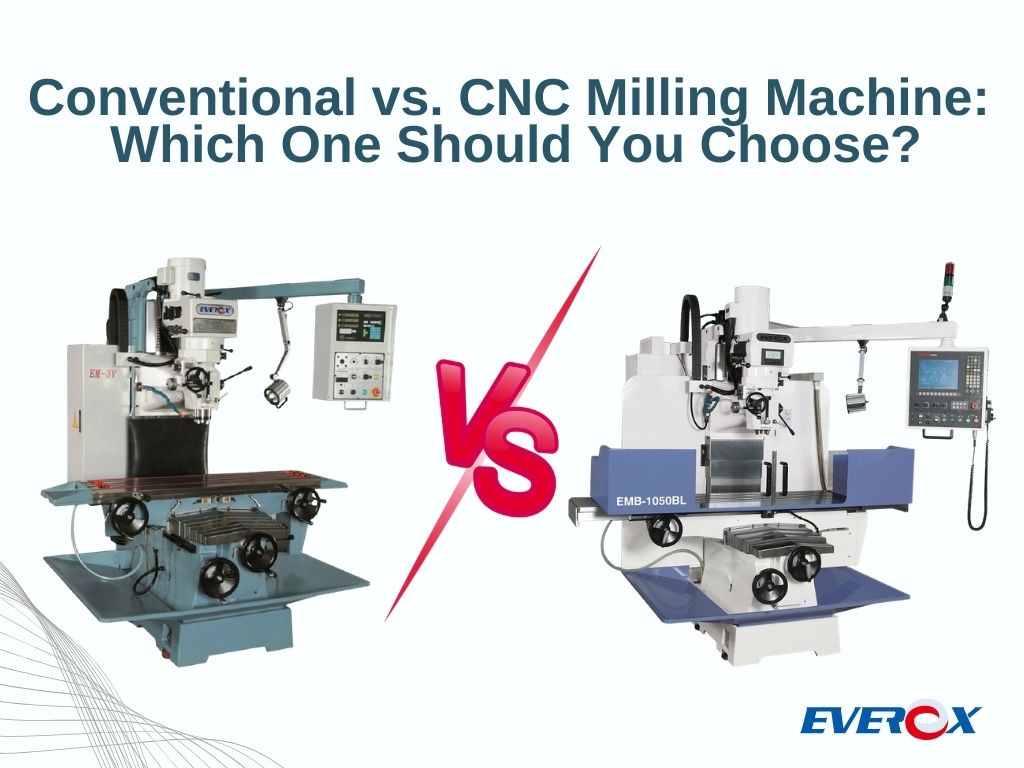
Introduction: Understanding the Real Difference
When investing in a milling solution, manufacturers often face a key question:
Should you choose a conventional milling machine or a CNC milling machine?
While both machines perform material removal using rotating cutting tools, the way they operate—and the type of production they support—differs significantly. Selecting the right option depends not only on budget, but also on production volume, part complexity, operator skill level, and long-term business strategy.
Understanding these differences helps ensure that your milling machine becomes a productive asset rather than a limitation.
What Is a Conventional Milling Machine?
A conventional milling machine (also known as a manual milling machine) is operated directly by a machinist. Movements along the X, Y, and Z axes are controlled manually using handwheels or mechanical feeds.
Advantages of Conventional Milling Machines:
- Lower initial investment
- Simple mechanical structure
- Flexible for small-batch or repair work
- Ideal for training and toolrooms
Conventional machines are commonly used in:
- Maintenance workshops
- Prototyping environments
- Educational institutions
- Small fabrication shops
Because the operator controls each movement, these machines allow for hands-on adjustment and quick improvisation. However, machining accuracy and repeatability depend heavily on operator skill.
What Is a CNC Milling Machine?
A CNC milling machine (Computer Numerical Control) automates machining operations using programmed instructions (G-code). Once the program is loaded, the machine performs movements precisely and repeatedly without manual intervention.
Advantages of CNC Milling Machines:
- High precision and repeatability
- Consistent production quality
- Faster cycle times
- Capability to machine complex geometries
- Reduced operator dependency
CNC milling machines are widely used in:
- Automotive production
- Aerospace manufacturing
- Mold and die making
- High-volume industrial production
Because movements are digitally controlled, CNC machines significantly reduce human error and improve productivity.
Key Differences Between Conventional and CNC Milling Machines
| Feature | Conventional Milling Machine | CNC Milling Machine |
|---|---|---|
| Operation | Manual control | Computer-controlled |
| Precision | Operator-dependent | High and repeatable |
| Production Volume | Low to medium | Medium to high |
| Part Complexity | Simple shapes | Complex geometries |
| Setup Time | Quick for simple jobs | Efficient for repeated runs |
| Labor Requirement | Skilled machinist required | Operator + programmer |
The table clearly shows that the right choice depends largely on production goals.
When Should You Choose a Conventional Milling Machine?
A conventional milling machine is suitable if:
- Your production volume is low
- Parts are relatively simple
- Budget constraints are significant
- You require flexibility for custom or repair jobs
- Skilled machinists are available
For small workshops and toolrooms, a manual milling machine remains a practical and cost-effective solution.
When Should You Choose a CNC Milling Machine?
A CNC milling machine is the better choice if:
- You require consistent repeatability
- Production volume is high
- Parts involve complex geometries
- Tight tolerances are critical
- You plan long-term automation
In modern manufacturing environments, CNC machines are essential for maintaining competitiveness, especially when precision and efficiency directly impact profitability.
Cost Considerations: Short-Term vs Long-Term Value
While conventional machines have lower upfront costs, CNC milling machines often provide better long-term return on investment due to:
- Reduced labor cost per part
- Higher production efficiency
- Lower scrap rates
- Greater scalability
Manufacturers should evaluate total cost of ownership rather than initial purchase price alone.
Hybrid Production Strategies
Many factories operate both conventional and CNC milling machines. Manual machines handle repairs and one-off projects, while CNC machines focus on standardized production.
This hybrid approach allows manufacturers to maximize flexibility while maintaining efficiency.
Choosing the Right Milling Machine Manufacturer
Beyond selecting the machine type, choosing a reliable milling machine manufacturer is equally important.
A trusted manufacturer provides:
- Rigid machine construction
- Stable spindle performance
- Precision guideway systems
- Long-term service support
- Technical consultation
At EVEROX Industrial Co., Ltd., we design both conventional and CNC milling machines to support different manufacturing strategies. Whether you require flexible manual machining or automated CNC precision, selecting the right supplier ensures long-term operational stability.
Frequently Asked Questions (FAQ)
1. Is a CNC milling machine always better than a conventional milling machine?
Not necessarily. CNC machines are superior for precision and high-volume production, but conventional machines are often more practical for low-volume or repair work.
2. Can a conventional milling machine achieve high precision?
Yes, but accuracy depends heavily on the operator’s skill and experience. CNC machines provide more consistent repeatability.
3. Which machine is easier to maintain?
Conventional machines have simpler mechanical systems, while CNC machines require electronic and software maintenance in addition to mechanical upkeep.
4. Is CNC worth the higher investment?
For medium to high production volumes and complex parts, CNC machines typically offer better long-term value.
Conclusion: The Right Choice Depends on Your Production Strategy
The decision between a conventional milling machine and a CNC milling machine is not about which technology is superior—it is about which one aligns with your production requirements.
Small workshops may benefit from the flexibility and affordability of manual machines, while industrial manufacturers rely on CNC systems for precision, efficiency, and scalability.
If you are evaluating milling machine options for your facility, consult EVEROX Industrial Co., Ltd. to receive expert guidance and discover the most suitable solution for your production needs.
✉ Contact EVEROX to explore milling machine solutions tailored to your production needs.